Disclosures, before anything else. Amanda King, the naturopath I recommend below, is a friend – I met her through an introduction shortly after my diagnosis and she became part of what I’ve called the A-Team. My integrative oncologist is Dr Hari Kuhan, who is happy to be named here, and I have a separate professional connection to the clinic he works from. I earn nothing from any of it and there’s no affiliate arrangement, but you should know all of that before you read a word of what I think, rather than find it out afterwards.
I’m not a doctor. I’m a Stage IV cancer patient who reads research and asks awkward questions, and everything below is my experience and my reading, clearly separated. Nothing here substitutes for your oncology team, and I’ll say plainly up front that everything I describe runs alongside conventional treatment rather than instead of it.
The dietary advice that came with my Stage IV diagnosis was sweets, chocolate and ice cream.
I’ve written elsewhere about why that advice wasn’t stupid – I couldn’t get food past a 9.2cm tumour and weight loss was the immediate threat – but it was also the entire dietary conversation on offer, and I’d just been handed 11.5 months. I wanted somebody whose actual job was to think about what I ate, what I took, and how the two interacted with treatment, and being that the NHS has no such person for somebody in my position, I went looking.
What naturopathy actually is
Naturopathy is a tradition of practice built on a handful of principles: treat the whole system rather than the presenting symptom, work on causes as well as effects, and support the body’s own capacity to recover rather than only intervening against disease.
In practice a naturopathic consultation looks nothing whatever like a fifteen-minute oncology appointment, covering diet, sleep, digestion, stress, history, bloods, environment and the interactions between all of them (my first ran to the better part of two hours), which makes it both slower and considerably broader.
One clarification matters more than anything else in this section. Naturopathy is a category rather than a treatment, so asking “does naturopathy work?” is rather like asking “does medicine work?” – it depends entirely which bit. Some of what sits under the naturopathic umbrella has decent evidence behind it, some has mechanism and no outcome data, and some has neither; anyone telling you the whole category works, or that the whole category is nonsense, isn’t thinking carefully.
How it differs from conventional medicine
The honest differences, in both directions.
What it does that conventional care doesn’t is time, mainly. My oncologist has fifteen minutes and a protocol to run, and that protocol is precisely where his attention ought to be – it isn’t his job to work out whether my magnesium is competing with something else in my stack, or whether my diet is deliverable by an actual human being with two small children. Naturopathic practice has room for the questions falling between specialisms, and cancer generates a great many of those.
What it can’t do is the part the enthusiastic sites leave out. A naturopath cannot diagnose you, cannot prescribe, and has no access to your imaging or your notes unless you choose to share them. They aren’t qualified to tell you whether to have chemotherapy, and a good one won’t try. Every piece of hard clinical decision-making in my care has been made by medically qualified people, which is the correct arrangement.
The regulation question, answered straight
This is the section I most wanted to read when I was looking, and couldn’t find anywhere. So here it is plainly.
Naturopathy isn’t statutorily regulated in the United Kingdom. There’s no protected title and no government-mandated licence, which means anyone can call themselves a naturopath – and that isn’t true of osteopaths or chiropractors, who have statutory regulators, so it’s a real difference rather than a technicality.
“ND” doesn’t mean medical doctor in the UK. It signifies naturopathic training, and if you take one thing from this article, take that.
What exists instead is voluntary registration, and the distinctions are worth knowing:
- The General Naturopathic Council (GNC) and the General Council and Register of Naturopaths (GCRN) are membership registers, where practitioners meet a training standard and sign up to a code of conduct.
- The Association of Naturopathic Practitioners (ANP) is a professional body.
- The Complementary and Natural Healthcare Council (CNHC) is the voluntary regulator set up with government support, and its register is accredited by the Professional Standards Authority, a body accountable to Parliament. That accreditation constitutes the strongest external marker available in this field, not least as it means somebody independent has assessed the register itself rather than the register assessing itself.
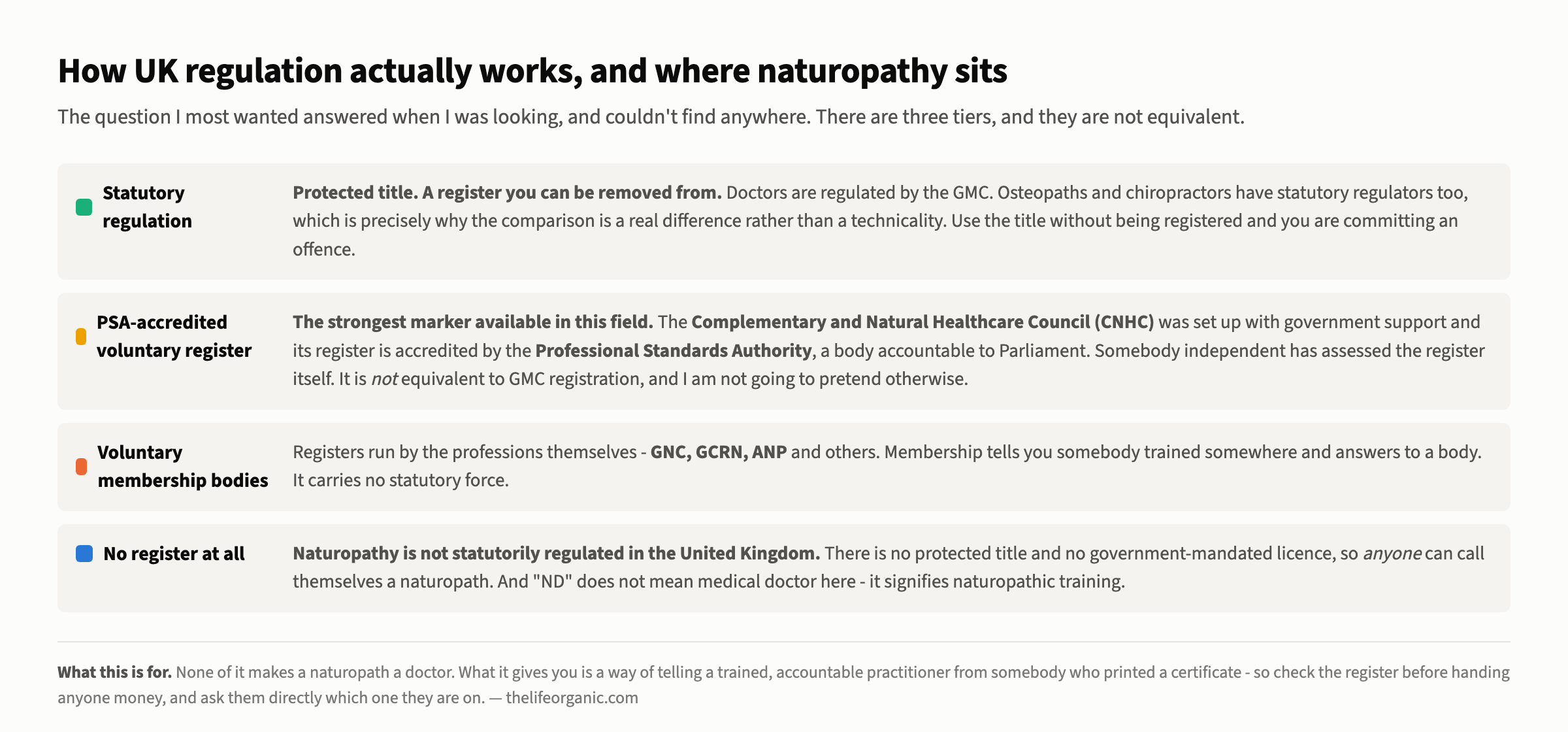
None of this is equivalent to GMC registration and I’m not going to pretend otherwise. What it does give you is a way of telling a trained, accountable practitioner from somebody who printed a certificate, and I’d check the register before handing anyone money.
Why I wanted both, rather than either
This is the part I’d most like people to take away, being that the framing is wrong very nearly everywhere you look. The choice isn’t naturopath or doctor; the two do different jobs, and the value sits in the overlap between them.
The integrative oncologist works on the medicine – off-label prescribing, reading my genomic sequencing, drug interactions, what is and isn’t safe alongside CAPOX and pembrolizumab, and when to stop something. He’s medically qualified, can prescribe, can read the scan, and carries the professional accountability that goes with all of it.

The naturopath works on everything the appointment has no room for – the diet, built around a real person rather than a downloaded protocol; the supplement stack and what interacts with what; bloods read functionally rather than only against a pass-fail reference range; and the week-to-week adjustment which nobody else has the capacity for and which turns out to matter enormously across two years.
And they catch different things. Two people looking at the same patient from different directions, both willing to say when they think the other has missed something, constitutes a considerably better safety net than one person looking from one direction, and it’s worked exactly that way for me more than once.
Why this combination specifically
The concrete example is the best argument I have.
Very nearly every metabolic oncology protocol in circulation is built around meat – Seyfried, the Metabolic Approach, the ketogenic literature generally, all of it assumes an omnivore. I’m vegetarian. I wasn’t going to stop being vegetarian, and I was being handed protocols which quietly assumed I would.
Amanda rebuilt it, and the result became my Stage IV protocol. Not “here are some vegetarian swaps”, but an actual adaptation which held the metabolic logic while working for somebody who doesn’t eat meat, and which I could sustain alongside chemotherapy, fasting and two small boys. That’s precisely the work a PDF from the internet cannot do for you, and it’s the clearest illustration I have of what you’re actually paying for.
Worth updating honestly: I’ve since moved from vegetarian keto to a low carb vegetarian diet, for reasons I’ve written about separately. That’s a change arrived at deliberately rather than by drifting off the plan, and having somebody to think it through with is exactly the point.
The second example is bloodwork. In January 2026 Amanda ordered a full functional blood chemistry analysis – the sort of panel looking at patterns across systems rather than flagging individual out-of-range values – and it surfaced things nobody had been looking at (thyroid markers in particular), being that it was nobody’s job to look.
What it costs
I’m going to give you the numbers before I give you the recommendation, as doing it the other way round is how people get led into spending money they don’t have.
Amanda’s published fees are £699 for an initial consultation, £300 for a follow-up, and £1,149 for a package of an initial plus two follow-ups – as at time of writing (July 2026).
That’s a lot of money and I’m not going to dress it up, though it’s also broadly in line with the field (I checked several others before booking) and it buys a considerable amount of time and preparation rather than a fifteen-minute slot. Whether it’s worth it depends entirely on your circumstances, and if it isn’t affordable then the Substack below is free and carries a good deal of the same thinking.
I’ve spent nearly half a million pounds on private healthcare across this illness, and I’m acutely aware that most people can’t, which is why the honest version of any recommendation I make has to include the price.
Amanda’s Substack, and why I point people at it
The Metabolic Nutritionist is, in my view, one of the genuinely useful free resources in this space.
Her own description of it: “Weekly newsletter by Amanda King, ND – Exploring Nutrition for Cancer, Off-Label Drugs, Supplements and Naturopathic Oncology. In clear, accessible language to empower your Cancer journey.”
What makes it worth your time is that it’s written by somebody who does this work daily with actual patients (rather than a content team working from press releases), covers the off-label and metabolic territory that patient groups discuss constantly and rarely well, and does so in language a frightened person can follow. If you’re navigating this and want one thing to subscribe to, that’d be my suggestion.
Her qualifications, for the record: BSc (OPEN), DipCNM, ND, CIMP, mANP, mGNC. She’s a registered naturopath and integrative oncology nutritionist, a graduate of the Integrative Metabolic Oncology Practitioner Master Course through the Metabolic Terrain Institute of Health, and certified in nutrigenomics.
She’s also a friend, which I said at the top and will say again here, so weigh it accordingly. I’d point you at her work if I’d never met her, but you’re entitled to know that I have.
How to choose a naturopath, if you’re starting from nothing
- Check the register – GNC, GCRN, ANP, or ideally CNHC given the PSA accreditation. Ask directly.
- Ask what they trained in, and where. A specific answer is a good sign.
- Ask whether they’ll talk to your oncology team. Anyone who resists that is telling you something.
- Ask what they don’t do. A good practitioner has a clear answer and gives it readily.
- Ask what it costs before the first appointment, tests included, being that those are often extra.
- The one absolute red flag is anyone who suggests declining, delaying or stopping conventional treatment. Walk away, however compelling the rest of it sounds – that single behaviour tells you everything, and people die of it.
What I’d want you to take from this
Not that you need a naturopath, and certainly not that you need mine.

What changed things for me wasn’t any single practitioner – it was realising that a fifteen-minute appointment is a constraint on the system rather than a limit on what can be known, and that I was allowed to go and assemble the rest myself. Some of that was reading. Some of it was asking questions I’d previously assumed were rude. Some of it was paying for time I couldn’t get free.
You may reach different conclusions, and you may reach them with entirely different people. That’s rather the point. What I’d hope is simply that you come away knowing the questions are askable, the registers are checkable, and nobody in this field should mind being asked what they can’t do.
Who should be careful with this
- 🔴 Anyone being encouraged to delay, decline or stop conventional treatment. This is the one absolute. It doesn’t matter how compelling the rest of the reasoning sounds, or how much you like the practitioner. Walk away, and please tell your oncology team what you were told.
- Anyone on active chemotherapy or immunotherapy considering a supplement stack. Interactions are real and frequently unknown, several common supplements affect the same liver enzymes that clear chemotherapy, and this needs somebody medically qualified in the loop rather than a protocol assembled from a forum.
- Anyone who can’t comfortably afford it. The fees are in this article for that reason, and the free reading is a legitimate place to start.
- Anyone dealing with a practitioner who won’t say what they don’t do, or who resists talking to your oncology team. Both are reliable signals.
This list is not exhaustive and reflects only what I’m aware of. There will be interactions and contraindications I haven’t thought of, and I’m a patient rather than a clinician – so please treat it as a prompt for a conversation with your own team rather than a complete safety screen.

Frequently asked questions
If you’re navigating this and trying to work out who to bring into your corner, please do let me know – I answer every message, though not always quickly.
Is a naturopath a doctor?
Not in the UK. “ND” indicates naturopathic training rather than a medical degree, and naturopaths cannot diagnose or prescribe; some practitioners hold other clinical qualifications as well, but the ND itself isn’t one.
Is naturopathy regulated in the UK?
Not by statute, and there’s no protected title. Registration is voluntary through bodies including the GNC, GCRN and ANP, and the CNHC register is accredited by the Professional Standards Authority, which is the strongest independent marker available.
Will my oncologist mind?
Some will, most are neutral, a few engage properly. The productive approach isn’t to ask permission but to tell them clearly what you’re doing, so that somebody competent is watching the whole picture – mine know exactly what I take.
Can a naturopath prescribe?
No. Prescribing requires a medical or other prescribing qualification, which is precisely why I have an integrative oncologist as well.
Is it worth the money?
For me, unambiguously – though I’d say two things: it’s a significant cost, and the free Substack carries a real amount of the same thinking, so start there if budget is tight.
What’s the difference between a naturopath and a nutritionist?
Considerable overlap and a different emphasis. Nutritional therapy focuses on diet and supplements, whereas naturopathy takes in a wider set of systems and lifestyle factors, and a good many practitioners, Amanda included, hold both.
Subscribe to stay connected