From where we left off
19th November to early-December 2024.
A month that didn’t fix anything but made everything possible.
I left my first NHS oncology appointment on 19th November with the phrase “palliative care only” lodged under my ribs like shrapnel. The plan, stated in clinical terms, was to extend, relieve, and support. In human terms, it meant not to expect miracles.
So, I did what anyone would do when everything feels uncertain – I built a floor. I didn’t wait for good news; I created a day that could carry me when the news was not good. If the outcome was uncertain, I would make sure the inputs were steadfast.
This is the story of those first 30 days: a routine that felt like rebellion, the science that gave me hope, the fasting that made hunger seem purposeful, the hyperbaric chamber that turned into my quiet office, and the moment a stranger on LinkedIn (Thank you again Martin Gillespie – Metabolic Health Strategist) changed my path by introducing me to Amanda King.
I wasn’t better yet. I still went in and out of the hospital, spent a week (amongst many other admissions) in a palliative ward managing pain, and kept losing weight like a faulty elevator. But I had something new and priceless: direction and drive.

Rebellion Disguised As Routine
“Palliative care only” is a guiding principle but not a way of life. I chose to see it as a boundary marker, not a rule to follow. If the map is tough, you design a better route.
So I structured my day like an engineer:
- Wake
- Stretch (hips, thoracic spine, neck – keep the body moving)
- Breathing exercises
- Red light panel + Read (research papers, books, notes)
- Drive to HBOT clinic
- 90 mins in an HBOT (read in the chamber; breathe; accept the science)
- Home + Further Research & Reading
- Lunch (or fast, depending on the day)
- Sauna + Answer Linkedin messages (I had over 2k backed up at this point)
- Ice bath (brief, uncomfortable, purposeful)
- Shower
- Read more on cancer biology
- Dinner (measured, vegetarian keto)
- Walk
- Read more cancer articles and research
- pEMF Mat + more Reading
- Bed
Then repeat it all again the next day.
I wasn’t seeking heroics. I was building capacity – mitochondrial, nervous-system, psychological. The day became a metronome; even when I felt weak, the rhythm kept me going.
Dark humor kept me grounded. My new “office” was a pressurised tube, and my “colleagues” were divers and retirees. There are worse ways to shift a crisis.
HBOT – The Quiet Room Where I Started Over
I started hyperbaric oxygen therapy on 11th November – before even waiting for that first oncology appointment. The dates seem out of order because grief had already distorted time; I was never one to sit on my hands and wait for approval.
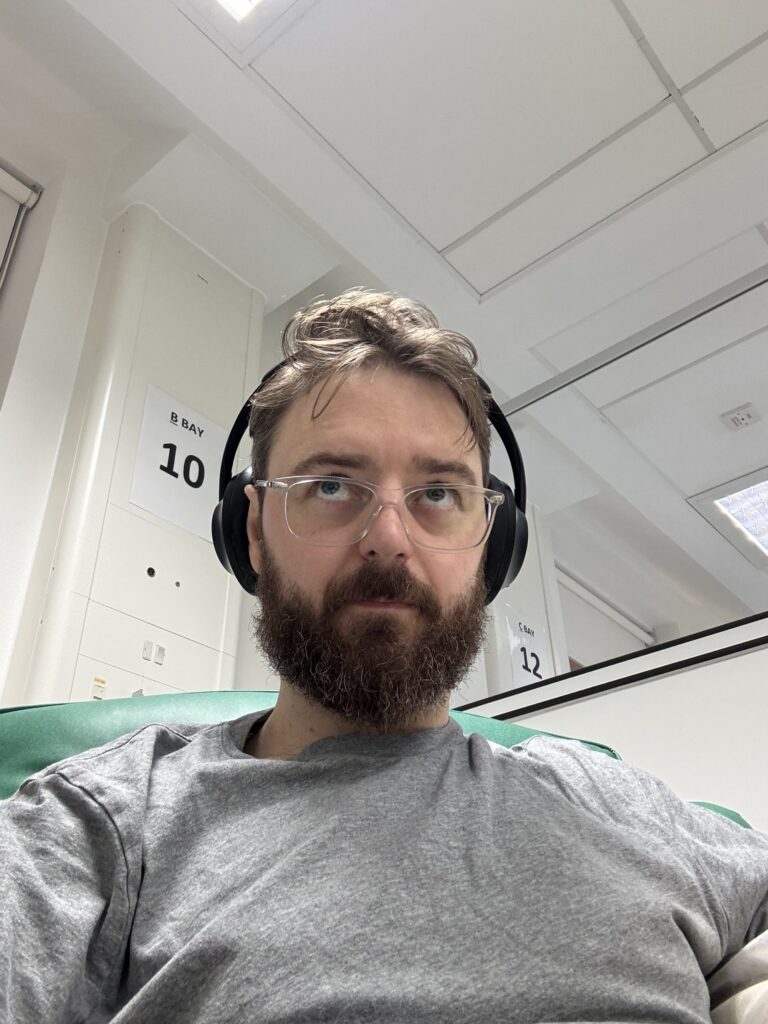
The chamber hissed, and the world shrank. Headset on. Red light cap giving the chamber a red glow. Book open. The mask enclosed me in a small, oxygen-rich choice: do the work. At 1.4 ATA, reading felt like a workout for the brain – dense, focused, strangely calming. I read papers on oxygen dynamics and tumor hypoxia, case studies, and protocols. I was never ignorant enough to think HBOT would cure me; I followed the evidence and believed oxygen and pressure were tools. Tools alter what other tools can accomplish.
During those first weeks, HBOT provided three practical benefits:
- A place to think where no one expected anything from me.
- A routine that didn’t rely on mood.
- A narrative I could accept: add oxygen, change chemistry, nudge biology.
I avoided antioxidants around my sessions, planned meals and fasting windows surrounding the chamber, and treated pressure like a lever, not a miracle. The hiss became routine. Routines became hope – not airy hope, but the kind that is practical.

Starving Dave – Vegetarian Keto, Then Water Fasting
I was already vegetarian; that wouldn’t change. But my fuel would.
The more I read about cancer metabolism, the more I saw diet as terrain, not a belief system. Having consulted with Dr Cooper – I quickly switched to vegetarian keto – low carb, moderate protein, fiber for gut health, fats I could trust. I measured, recorded, and stayed honest. When my mind craved toast, my ketone meter answered for me.
Then I discovered water fasting.
Fasting is a unique teacher. It removes distractions – the quick rewards, the snacks that pretend to be emotions. In those first 30 days, I tried cautious 48 to 72 hour fasts, watching glucose and ketones (I use a Keto Mojo meter), noticing how my mind cleared on the second day as if someone had opened a window. I didn’t confuse that clarity with a cure; I treated it as extra operating space.
A line from Kelly Turner’s Radical Remission struck me: “The most important thing I learned is that cancer is my body. It’s not an enemy; it’s still my body.” – quotes courtesy of Goodreads
Fasting changed my relationship with my body. It wasn’t a battle against it, but a way to help it – reduce insulin load, lessen noise in the bloodstream, and exercise control. It wasn’t easy. It wasn’t supposed to be. It was straightforward.
Because people ask: yes, I saw small improvements – a quieter stomach and slightly more stable energy some days – but I was still going in and out of the hospital and feeling very unwell. Early gains were fragile. The goal wasn’t transformation; the aim was direction.

The Reading That Changed My Brain
Hyperbaric sessions became my reading time. I carried books and my iPad, filled with downloaded research papers and oncology trial data, like charms.
- Jane McLelland – How to Starve Cancer …without starving yourself. I didn’t see it as doctrine. I viewed it as a blueprint – a way to visualise metabolic pathways and think in systems. Her “Metro Map” metaphor helped me grasp why blocking multiple fuel routes might matter and why targeting just one pathway is like closing a single lane on a ten-lane highway. (For those new to this concept: Jane’s framework shows how to cut cancer’s fuel sources across glucose, glutamine, fat, etc., often through diet and repurposed medications. It’s not magic; it’s strategy.)
- Kelly A. Turner – Radical Remission. If Jane’s book provided me with mechanism, Radical Remission brought me meaning – patterns across unusual recoveries that emphasised agency, purpose, social support, and active participation in one’s own care. I didn’t take it all in at once; I let it motivate me to act where I’d felt stuck. (Her book outlines nine common factors; the common thread is patients becoming engaged decision-makers.)
A few days later, on the ferry to Guernsey to collect a sauna from my dad’s storage, I listened to Thomas Seyfried talk about the metabolic theory of cancer, on a Diary of a CEO with Steven Bartlett. The sea was iron-grey, and my notes were full of exclamation marks. I emailed him as soon as I reached the dock. He responded within hours and immediately connected me with Dr. Isabella Cooper at the University of Westminster – clinical mind, metabolic focus, compassion without fluff. That introduction was really significant. It shifted curiosity into learning.
(For those unfamiliar with this perspective: I’m not suggesting a cure. I’m saying that viewing things through a metabolic lens gave me a way to make decisions that felt sensible when everything else felt random.)

The Week In The Wrong Ward
I spent over a week in a palliative ward for pain management during that first month. It was the right choice clinically. It was the wrong place for my mindset. There were deaths. There were nighttime screams. There were some difficult conversations with doctors. I didn’t know if/when I was going to get to leave.
The staff were the embodiment of kindness – the kind of people who restore your faith in humanity whilst your body is at odds with itself. But the pace of that ward altered time. Days became blindingly slow – especially given the level of pain I was in. I realised I didn’t want my story to be passive. I wanted it to be created.
So I wrote lists – things to learn, things to test, people to contact, questions to ask. I drafted a simple protocol outline (diet, oxygen, movement, off-label options to investigate) and set homework for myself. Medical staff addressed my pain (with Oxycodone, Pregabalin and a few others too); I would have to provide my own sense of purpose.
I’m not glorifying endurance; morphine and oxycodone both prove that bravery has limits. I’m just saying that when pain brought me low, having a plan helped me rise again.

Sauna And Ice – Nervous System Engineering
About that sauna: here I’ll be focusing on the mental side, as opposed to medicinal – I’ll be covering the medical side in more detail in a future post.
Heat and cold provided me with simple, physical gains. Heat released tension I didn’t realise I was holding. The ice bath offered a controlled challenge – a practice in staying calm. Inhale, exhale, count to 60, then another 60. It’s not about overcoming matter or pain; it’s about working with it.
No biohacking myths here. Just inputs. When life became abstract (PET scans, prognoses, research), the body was my space to practice in the moment.
Vegetarian Keto – Without Dogma
I kept it simple and remained vegetarian:
leafy greens and cruciferous veg (lots of broccoli) as the base; olive oil, ghee, coconut oil, avocado, nuts, and seeds for fats; halloumi and eggs or plant proteins (tofu/tempeh) for controlled protein; psyllium, chia, and flax for fiber; electrolytes and minerals (lots of baja gold salt especially) to prevent muscle cramps.
Meals were small and spaced out. Blood glucose stabilised better when I walked after dinner – ten minutes of stubbornness can sometimes make the numbers a bit kinder.
This wasn’t about morality. It was about practicality – creating meals I could manage whilst parenting and commuting to pressurised spaces.

The Tab I Opened… And Haven’t Closed (Yet)
I said I wouldn’t discuss off-label meds here, and I won’t – at least, not yet. But I want to be honest about the mindset during those 30 days.
I joined lots of facebook groups and read about people’s stories of taking canine or equine grade medications. I read about methylene blue and its effects on mitochondria. I even researched an unusual plant extract – “black bat flower” – supposedly sourced from the Amazon and used by the ancient inhabitants of the area to treat cancer – though that seemed more folklore than scientific.
At that point, with a complete lack of direction, I approached everything the same way: mechanisms first, evidence second, no hype. Most items landed in the “interesting, not yet” folder.
What mattered about that reading was not the potential treatments; it was the discipline. If something didn’t pass the safety and plausibility checks, it stayed away from my bloodstream.
Reading, Moving, Breathing – The Unsexy Trinity
I thought of exercise as essential, even when it boiled down to the bare minimum. If I could walk, I walked. If not, I did seated stretches (Sarah-Beth’s seated yoga became a favourite) and focused on my breath. Even ten minutes counted. It wasn’t about breaking a sweat; it was about sending a signal to my brain that the body was still alive and functioning.
Breathwork played a quiet but crucial role: long exhales, slow nasal breathing – techniques that help shift the nervous system towards “rest and digest” when every part of me wanted to stay in “fight or flight.” If you’ve never had to relearn exhaling, you might not realise how intense stress can be.
I approached sleep as a form of therapy, and completely non-negotiable – which, in this context, it truly is. Dim lights. No screens. A calming routine as medicine. Was it perfect? No. Was it a structure? Yes.

The People Who Steadied Me
In those first weeks, there were only a few names on my life's whiteboard:
- Ana, who was healing from her own surgery, somehow arranging our days into pockets of normalcy for the boys.
- My dad (Sam), a source of practicality and unending support, storing saunas in Guernsey like a very specific type of pirate.
- Dr. Isabella Cooper, who met my urgency with calm science and offered me a framework for learning instead of spiraling.
It wasn’t a crowd. It was a triangle – enough to provide support.
What I Underlined (Short Excerpts)
Two brief lines resonated with me – one intellectual, one personal:
“The most important thing I learned is that cancer is my body. It’s not an enemy; it’s still my body.” – Kelly A. Turner, Radical Remission
From Jane McLelland, I didn’t focus on a single sentence but on a concept: treat cancer metabolism as a transit system and block multiple fuel routes at once – glucose, glutamine, fat – with diet and (when appropriate) repurposed medicine. That image – the Metro Map – simplified the complex.
These two ideas – this is still my body, and close the fuel routes – sat together in my notebook like a personal agreement.

How A Day Became A Direction
By week three, my schedule felt less like punishment and more like I was in control:
- HBOT most days; reading in the chamber.
- Sticking to a vegetarian keto diet; cautious fasting windows included.
- Sauna and ice baths most afternoons; short walks after dinner.
- Notebooks: questions, experiments, what to set aside, what to pursue.
- Communicate clearly with my NHS team; don’t hide anything (even when they disagree or try to dissuade you); keep the relationship respectful.
- Keep the boys’ world as bright as possible, deflate balloons slowly.
Did I feel better? Sometimes. Was I still getting admitted for symptom control, dehydration, and pain? Yes. But the ratio slowly began to change: there were more hours where I was doing something than hours where something was happening to me.
If medicine had given me a category and a staging, I had given myself a calendar.
The Message That Moved Everything
The thing about sharing your story online is that sometimes the right people find you. Sometime in mid-November, a message showed up in my LinkedIn inbox from Martin Gillespie. He had seen my posts, recognised the metabolic thread, and reached out to offer support.
We spoke. He listened like someone who understood my struggles – having been through it himself. Then he said something like, “You should talk to Amanda King.”
That introduction marked the end of the first month and the start of something new. Amanda, a very talented naturopath and nutritionist (and my very favourite person I’ve met along this horrible journey), would help me define and find the macros that worked for my specific biology and situation, even though her usual approach is meat-based keto. But that’s for the next chapter.
This one ends with a simple fact: within 30 days of being told I was palliative only, I had a repeatable day, a scientific lens, a shortlist of sensible experiments, and a small, strong network. I wasn’t improving yet. But I was not tumbling. Not anymore.

Closing
If Part 1 of my story was the fortnight everything fell apart and Part 2 was the week grief and prognosis collided, then this is the chapter where I traded my initial panic for focus and planning.
It wasn’t progress yet, but it was purpose. And if medicine had given up, I’d make metabolism my new battlefield – I’ve also written a string of blog’s on the Warburg effect, in case you want to know why metabolism does matter
Subscribe to stay connected